



As told by Dr. Elena Hartwell – family therapist specializing in aging, memory, and parent-adult child relationships.
Many of my clients are entering retirement or dealing with major life transitions.
They talk about nostalgia, uncertainty and curiosity about what comes next.
One of the simplest, most powerful tools I recommend to feel calmer and more connected to family is to tell your story.
Here are 8 strong benefits of writing your memories – whether it’s a few lines at a time or deeper reflections.
#1 It Boosts Memory Clarity & Recall
Writing helps you to revisit and connect with old memories.
Studies show that when older adults revisit and write about their past, their memory becomes clearer and their thinking stays sharper. (1, 2)
Many people tell me, “I didn’t remember half of this until I started writing.”
That is exactly how memory works: once you unlock one moment, dozens follow.
#2 It Lowers Stress by “Offloading” Emotions

Emotional writing, sometimes called expressive writing, has been shown to support both emotional and physical health.
Research links it to lower blood pressure, reduced stress hormones, better sleep, and greater emotional resilience.
When you write, you’re not just journaling – you’re releasing. (3, 4)
For many adults I work with, writing becomes a safe way to unload years of emotions.
#3 It Strengthens Your Sense of Identity
Our identity is shaped by our memories, our challenges, and our triumphs.
According to narrative psychology, our life stories play a major role in who we become.
Writing your story helps strengthen that understanding:
“My life has meaning.”
Writing helps you reconnect with:
who you’ve been
who you are
and who you’re becoming (5)
This is especially helpful at retirement, when old roles change and a sense of purpose can feel shaken.
#4 It Helps You Make Sense of Your Life Timeline

Many people over 55 tell me the same thing:
“It’s strange how the years blur together.”
Writing untangles that blur. You start to see patterns (6):
turning points
circles of events
choices you made
lessons you learned
This process is a core part of life-review therapy: a well-established therapeutic practice.
It helps older adults feel more organized, settled, and at peace with their past.
#5 It Passes Down Wisdom Across Generations
Lived experience carries a kind of wisdom nothing else can replace.
Research finds that when older adults pass down their stories, younger generations feel more connected and emotionally secure.
By writing your story, you’re giving your family something lasting – something they’ll return to for comfort.
Often, it’s the everyday moments that become the most meaningful part of a family’s legacy. (7)
#6 It Activates Your Natural “Legacy Instinct”

As humans age, many develop what psychologists call a legacy motivation.
It’s a desire to make meaning out of one’s life and pass something forward.
This instinct is deeply healthy – it's part of Erik Erikson’s well-known developmental stage of “generativity.”
Writing your story activates that instinct (8).
You’re shaping something that will outlive you, something that tells the next generation:
“This is where you come from.”
#7 It Reinforces Positive Memories
Writing positive memories does more than record them – it re-experiences the emotions.
Research in narrative therapy shows that revisiting good memories boosts optimism, gratitude and well-being (9).
Many of my clients say writing feels like “reliving the good parts of life” – a benefit that becomes more precious with age.
#8 It Promotes Calm & Emotional Balance

Writing is a naturally regulating activity.
It slows your breathing, organizes your thoughts, and engages the parts of the brain responsible for reflection rather than reactivity.
Even 10-15 minutes a day can:
calm the nervous system
improve mood
reduce feelings of loneliness
increase emotional stability (10)
For many retired adults, writing becomes a peaceful daily ritual – like tea in the afternoon or a walk after dinner.
Why I Recommend Memowrite to My Clients Who Want to Journal or Write a Memoir
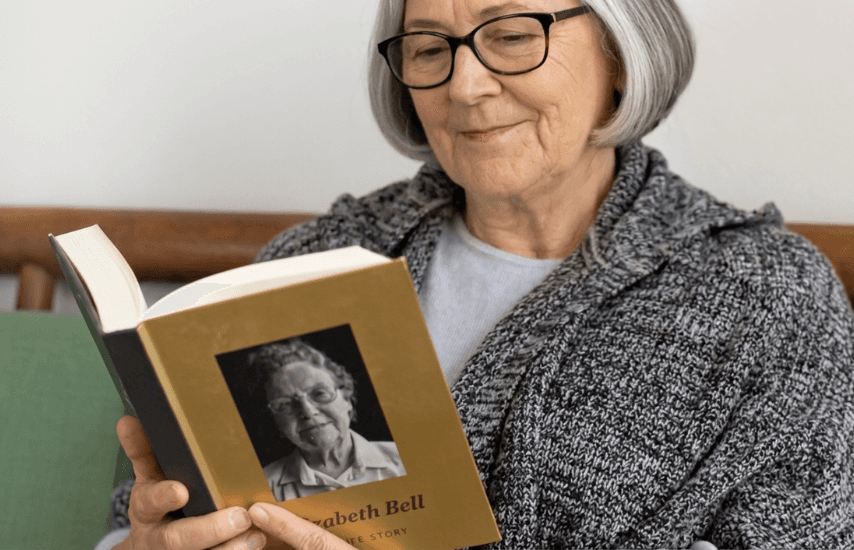
Many of my clients want to write, but then they say: “Where do I even start?”
That’s why I often suggest Memowrite.
It removes the most common barriers: getting started and keeping going.
Here’s why it works especially well for adults 55+:
50 guided questions
Thoughtful, gentle prompts naturally unlock memories.
You can write or simply speak your answers – a feature many of my older clients find much easier.Your story, preserved forever
When you’re done, Memowrite turns your words into a beautifully printed hardcover book.
It becomes something your family can actually hold, read, and treasure.Unlimited photos + photo restoration
Add all the photos you want to your book to accompany your memories.
Old or faded images can be enhanced, brightened, or lightly restored – letting you experience the past just as you saw it.No tech stress
The platform is simple and designed with older adults in mind.
Most of my clients describe it as “surprisingly easy” and even “calming”.
In Summary: Your Story Deserves to Be Written
Whether you simply journal your thoughts or go all the way to create a full memoir, writing your story is one of the most rewarding things you can give yourself.
It offers clarity, peace, connection and meaning – especially as you move into retirement or look ahead to the next chapter.
And with tools like Memowrite, the process becomes easier, gentler, and much more enjoyable.
Your story is worth telling. And you’re not too old to begin.
AS SEEN IN:


Ida Zbirochowicz
8 Sep, 2025 at 2:14 pm
I lived through the events of the cold war period in Europe, escaped to Vienna by a special train with my money hidden in the toillet bowl. Then without my document worked…….
Nur Rachmi
24 Jul, 2025 at 1:50 pm
I’m 63, and I’ve been thinking along this line, to start preparing a memoir.
Anne
23 Jul, 2025 at 10:05 pm
This would be a great idea! I never know what or where to start!
Elena GRAJALES pereyra
23 Jul, 2025 at 6:50 pm
I would love to give it a try
susanne scholtz
23 Jul, 2025 at 5:19 pm
I would love to do this